Dubai Metro Blue Line Reshapes Dubai
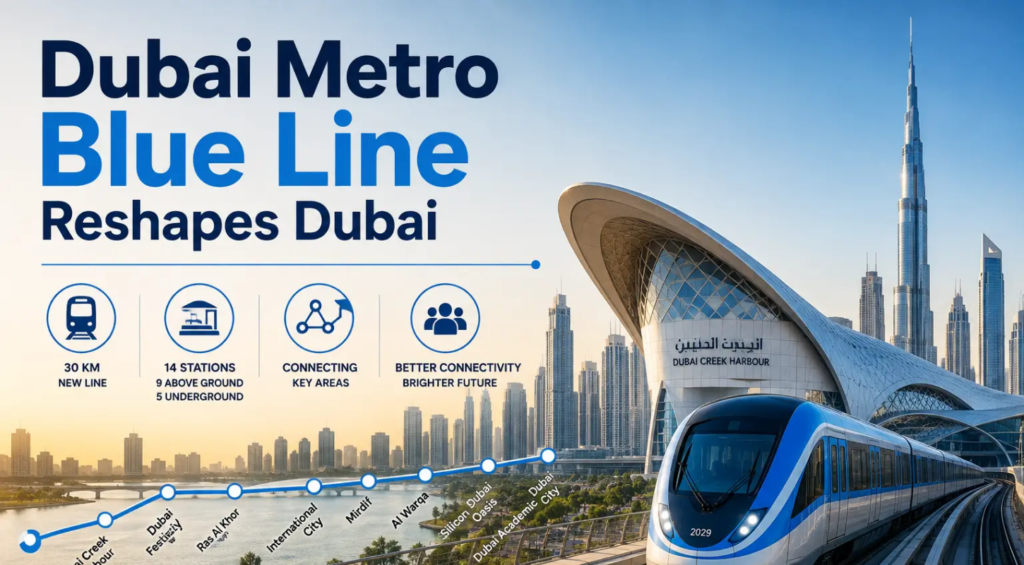
Dubai Metro Blue Line is taking shape: what does this mean for the city? Dubai is known worldwide for its impressive skyline and ambitious real estate projects. Less visible, but just as important, are the investments the city is making in its infrastructure. No matter how attractive new residential and business districts may be, good connections ultimately determine how well a city functions. The Dubai Metro Blue Line is a good example. Over the past period, new details have been announced about the route, stations and design of the project. This is providing an increasingly clear picture of what the metro will look like from 2029 onwards and which parts of Dubai will become better connected. For residents, this means more travel options and shorter journey times. For the real estate market, it is another development that shows Dubai’s continued investment in the city’s growth. The largest expansion of the Dubai Metro since 2011 The Blue Line will be the largest expansion of the metro network since the opening of the Green Line. The new line will be approximately 30 kilometres long and will consist of 14 stations, nine above ground and five underground. The line will also connect to both the Red Line and the Green Line, making it easier for passengers to transfer between lines and allowing a larger part of the city to be reached by metro. According to the current schedule, the Blue Line is set to open on 9 September 2029, exactly twenty years after the first Dubai Metro became operational. Which areas will benefit from the Blue Line? The new metro line will connect several areas that have developed significantly in recent years or where substantial further development is planned in the years ahead. The route will include: This combination is precisely what makes the Blue Line interesting. It will not only serve established residential areas, but also locations where many new homes, offices, educational institutions and amenities are expected to be developed in the coming years. Dubai Creek Harbour is getting an iconic metro station One of the most striking elements of the project is the new station in Dubai Creek Harbour. The station was designed by Skidmore, Owings & Merrill (SOM), the architecture firm behind the Burj Khalifa. At approximately 74 metres high, it is expected to become the tallest metro station in the world. This reflects the way Dubai approaches major infrastructure projects. Functionality naturally plays an important role, but considerable attention is also given to architecture and appearance. The station is intended not only to accommodate passengers, but also to become a new landmark within the city. The Blue Line is part of a bigger plan The Blue Line is not the only infrastructure project Dubai is currently working on. Earlier this year, the introductory phase of Etihad Rail was announced, while the first plans for the future Dubai Metro Gold Line have also been revealed. In the future, this line is expected to connect areas including Business Bay, Meydan and Jumeirah Golf Estates and link them to the existing metro network. Together, these projects show that Dubai is not only continuing to invest in new real estate developments, but also in the infrastructure needed to support the city over the coming decades. Why do we follow developments like these? We look beyond new project launches alone. Infrastructure is often an important factor in the development of a city. New metro connections improve accessibility, support the growth of new residential areas and help different parts of Dubai become better connected. This does not mean that the arrival of a metro station automatically leads to higher property prices. The real estate market is influenced by many other factors. However, projects like these provide a useful indication of where the government is investing in the years ahead and which areas are expected to play an important role in the city’s continued development. That is exactly why we follow these developments closely. Not only because they are relevant to residents, but also because they provide valuable insights into the future of Dubai’s real estate market. Sources · Gulf News. (2026). Dubai Metro Blue Line and Gold Line: Routes and Station Locations Explained. · Time Out Dubai. (2026). Dubai Metro Blue Line: Here’s Where the 14 New Stations Will Be Located. · Roads and Transport Authority (RTA), Dubai. Dubai Metro Blue Line Project. (Official project information.)
Etihad Rail: Connecting the UAE’s Future
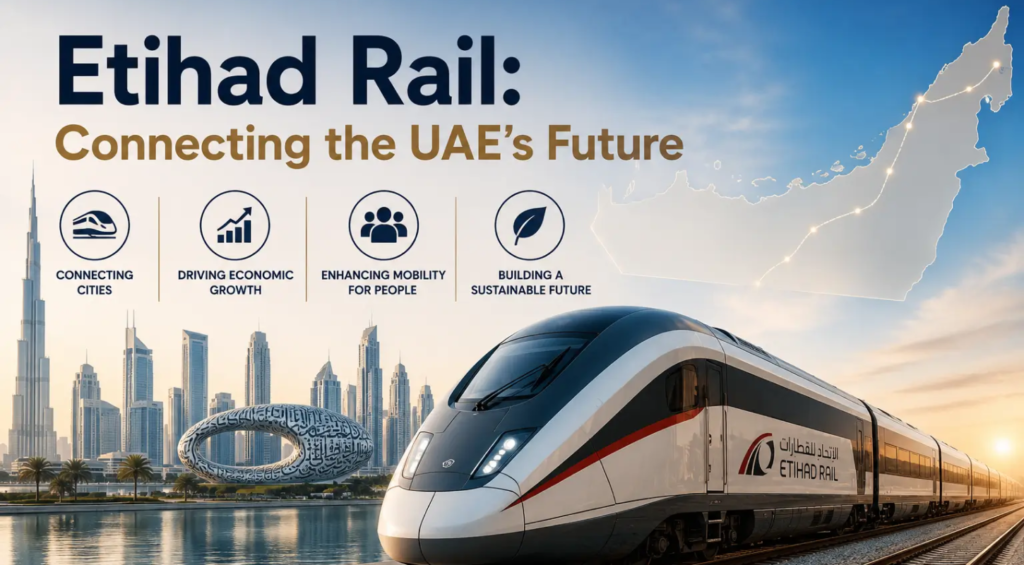
Etihad Rail officially launches: what does this mean for the future of the UAE? The United Arab Emirates is known worldwide for its impressive skyline and ambitious real estate developments. But behind this visible growth lies something equally important: the infrastructure that connects cities, businesses and people. With the launch of Etihad Rail’s first passenger service on 30 June 2026, the UAE is taking another important step in its development. The first train operates between Abu Dhabi and Fujairah, covering the journey in approximately 1 hour and 45 minutes. For the first time, the country now has a national intercity rail connection for passengers. What is Etihad Rail? Etihad Rail is the developer and operator of the United Arab Emirates’ national railway network. The project was established to improve connectivity between the seven emirates and forms an important part of the UAE’s long-term vision for economic growth, logistics and sustainable mobility. The network spans more than 900 kilometres and connects major cities, ports, industrial areas and logistics hubs across the country. Until now, the railway has primarily been used for freight transport. The introduction of passenger services marks a new chapter in the development of the network. The first passenger connection is just the beginning The introductory route between Abu Dhabi and Fujairah is the first phase of a much larger passenger network. According to the current schedule, the expansion will take place in several phases: Ultimately, Etihad Rail is expected to connect 11 cities and regions across the UAE. This will create, for the first time, a nationwide passenger rail network that allows residents and visitors to travel more easily between the different emirates. Why is the UAE investing so heavily in rail infrastructure? Over the past twenty years, the UAE has developed into an international hub for trade, tourism and entrepreneurship. That growth requires more than new residential communities, offices and airports. As cities expand and the population grows, well-connected infrastructure becomes increasingly important. Etihad Rail therefore forms part of a broader strategy to: The project is therefore closely aligned with the UAE’s broader ambition to invest in sustainable economic development and high-quality infrastructure. What does this mean for Dubai? Although the first passenger service does not yet run through Dubai, the city is set to gain an important position within the national network later this year. With the opening of the station at Jumeirah Golf Estates, Dubai will be connected to Etihad Rail. Over time, this will provide direct connections to Abu Dhabi, Fujairah, Sharjah and other parts of the UAE. This fits into Dubai’s wider development strategy. The city is not only investing in new residential communities, hotels and commercial developments, but also in the infrastructure needed to support this growth. This includes the expansion of the Dubai Metro, new roads and airports, and now a connection to the national railway network. More than just a train connection Etihad Rail is more than simply a new way to travel from A to B. The project connects cities, supports economic growth and forms part of a broader vision in which the different emirates become increasingly interconnected. For residents, this means more mobility options. For businesses, it creates more efficient connections between economic centres. For tourists, it will become easier to visit multiple emirates during a single trip. For the real estate market, it once again highlights the UAE’s continued investment in the infrastructure needed to support future growth. Projects such as Etihad Rail demonstrate how the United Arab Emirates continues to invest in accessibility, economic development and stronger connections between the emirates. It is precisely this combination of real estate, infrastructure and long-term vision that makes the UAE one of the most dynamic real estate markets in the world. Sources Etihad Rail. (n.d.). Passenger. Accessed 13 July 2026. Khaleej Times. (2026). Etihad Rail to begin introductory phase of passenger train services on June 30. Accessed 13 July 2026. Time Out Dubai. (2026). Etihad Rail: Confirmed station locations and launch dates. Accessed 13 July 2026.
Abu Dhabi: A Global Investment Destination
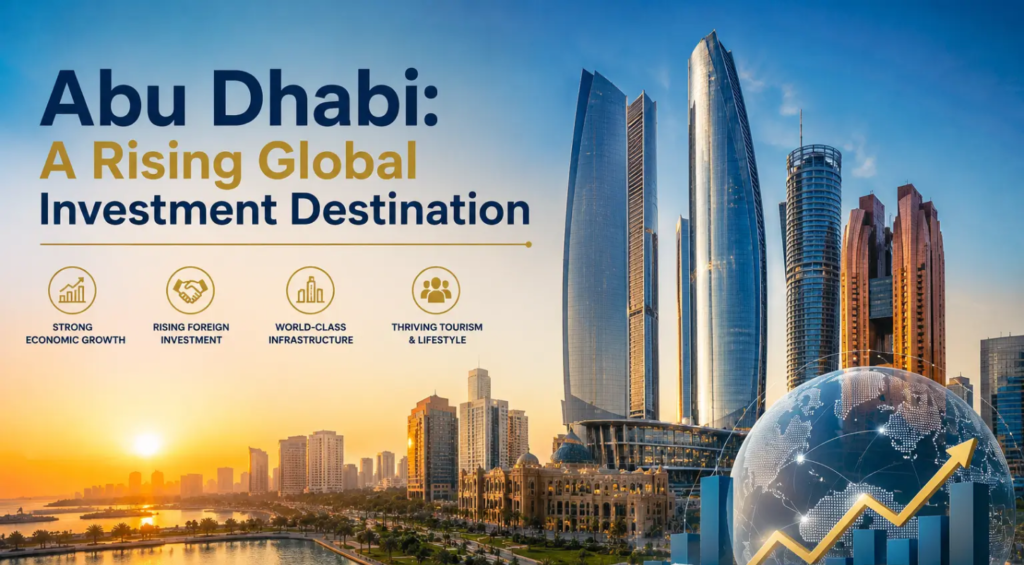
Why Abu Dhabi Is Increasingly on the Radar of International Investors When discussing real estate in the United Arab Emirates, Dubai is often the first name that comes to mind. However, a clear shift is taking place: Abu Dhabi is attracting increasing amounts of international capital and is rapidly developing into an interesting market for investors looking beyond Dubai. This is no coincidence. Behind the strong real estate figures lies a broader strategy in which Abu Dhabi is not only investing in housing, but also in infrastructure, tourism, culture and economic growth. It is precisely this combination that makes the city increasingly interesting from a long-term perspective. The Numbers Show a Clear Trend Abu Dhabi’s real estate market recorded a strong first half of 2026. According to recent market data, the value of property sales increased by 174% compared with the same period a year earlier, reaching AED 84.49 billion in the first half of 2026. International investment also increased significantly. According to the Abu Dhabi Real Estate Centre (ADREC), foreign direct investment in real estate reached AED 13.8 billion during the first half of 2026, representing an increase of 309%compared with the same period last year. Non-resident investors from 116 different nationalities were active in the market. These figures show that growth is not being driven by local buyers alone. Abu Dhabi is increasingly attracting investors from around the world. Abu Dhabi Is Investing in Complete Communities Abu Dhabi’s development goes beyond simply building new homes. New residential areas are being developed alongside infrastructure, leisure facilities, education, culture and public amenities. This creates complete communities rather than isolated real estate projects. For residents, this contributes to a higher quality of life. For investors, it means that the attractiveness of an area does not depend on a single project, but also on the development of the wider community. Yas Island Shows Where Abu Dhabi Is Heading Perhaps no area illustrates this better than Yas Island. What started as a leisure and entertainment destination has developed into one of Abu Dhabi’s most recognised areas. Ferrari World, Warner Bros. World, SeaWorld Abu Dhabi and Yas Marina Circuit have already helped put the island on the international map. With the announced arrival of the Middle East’s first Disney theme park resort, Yas Island is set to receive another major international boost. Disney and Miral announced in 2025 that the new resort will be developed on Yas Island. This is about more than the arrival of another theme park. Major international destinations attract visitors while also creating opportunities for hotels, restaurants, retail and other businesses. In this way, tourism, residential development and economic activity can reinforce one another. Waterfront Remains a Strong Segment Waterfront real estate continues to play an important role in Abu Dhabi’s property market. Communities such as Saadiyat Island, Al Reem Island, Al Raha Beach and Fahid Island continue to attract significant interest from buyers and investors. Their waterfront locations, high-quality amenities, beaches and relatively limited supply contribute to the appeal of this type of real estate. Recent market data further highlights this demand. Waterfront developments on Al Reem Island, for example, have significantly outperformed comparable non-waterfront projects in recent years. That does not mean that every waterfront development is automatically a good investment. Location, developer, purchase price, supply and future developments remain important factors. However, demand for this segment provides a clear indication of the qualities buyers value in Abu Dhabi. Infrastructure as a Foundation for Growth Abu Dhabi’s development is not limited to real estate. Projects such as Etihad Rail are improving connectivity between Abu Dhabi and other parts of the United Arab Emirates. At the same time, investments continue to be made in roads, public transport and the further development of strategic areas. Strong infrastructure does more than make a city easier to access. It also supports the growth of residential communities, business districts and tourism destinations. For real estate investors, infrastructure is therefore an important factor to monitor. New connections can influence how accessible certain areas become and how attractive particular locations may be in the future. An Economy Looking Beyond Oil Another important development is the continued diversification of Abu Dhabi’s economy. Through Abu Dhabi Global Market (ADGM), the city is strengthening its position as an international financial centre. An increasing number of international financial institutions, asset managers, investment funds and fintech companies are establishing a presence in Abu Dhabi. In the first quarter of 2026, ADGM reported more than 13,000 active licences and a 57% increase in assets under management. Abu Dhabi is also investing heavily in sectors such as technology, healthcare, education, renewable energy and tourism. This economic diversification is also relevant to the real estate market. More businesses and international professionals create additional demand for homes, offices, amenities and high-quality communities. Dubai and Abu Dhabi: Two Different Markets Dubai and Abu Dhabi are often compared, but the two real estate markets have their own distinct characteristics. Dubai is known for its international character, large supply of new developments and rapid pace of growth. Abu Dhabi has a different dynamic, with quality of life, space, economic diversification and the development of complete communities playing an important role. For investors, it therefore does not always have to be a choice between Dubai or Abu Dhabi. Both markets offer different opportunities and can complement each other within a broader UAE real estate strategy. Which market is most suitable ultimately depends on the investor’s objectives, budget, risk profile and investment horizon. Conclusion Abu Dhabi’s growth is not the result of a single successful real estate project or a temporary surge in the market. Its current development is supported by a broader strategy in which real estate goes hand in hand with investment in infrastructure, the economy, culture, tourism and quality of life. The strong growth in property sales, increase in foreign investment, continued development of Yas Island, expansion of ADGM and investment in national infrastructure together demonstrate just how broad this transformation is. It is precisely this combination that makes Abu Dhabi